Wednesday, November 11, 2020

Maß- und Rangierbücher des Zweiten Husaren Regiments 1787 - 1806


Angelegenheiten des Husarenkorps 1764 - 1806

Angelegenheiten des Husarenkorps 1764–1806 (“Affairs of the Hussar Corps”) is an administrative and regimental record covering the organization, service, and internal matters of a Hessian hussar formation during the late 18th and early 19th centuries. It relates to the cavalry forces of the Electorate of Hesse, a state well known for maintaining disciplined, exportable military units within the subsidy system of the period.

The content of such a record typically includes correspondence, orders, personnel lists, disciplinary cases, recruitment and discharge information, and reports on readiness and deployment. Covering the years 1764–1806, it spans a highly dynamic period in German military history, including the late Enlightenment era, the upheavals of the Revolutionary Wars, and the reorganization pressures brought by the Napoleonic conflicts within the Holy Roman Empire.

A key focus is the development and operational use of the hussar corps as light cavalry. Hussars were valued for reconnaissance, skirmishing, raiding, and communications duties, and the Hessian units were shaped by both Central European cavalry traditions and broader European tactical reforms. The records likely reflect evolving doctrines of mobility, discipline, and frontier warfare, especially as these troops adapted to changing battlefield conditions in the late 18th century.

The time span of the document also makes it significant for tracking the transition from early modern to Napoleonic military structures. By 1806, the political and military collapse of the Holy Roman Empire fundamentally altered the status of many German contingents, including Hessian forces. As such, the records provide insight not only into daily regimental administration but also into institutional continuity and disruption during a period of major geopolitical transformation.


Sunday, May 10, 2020

Die Deutschen Freikorps 1809 im Böhmen (Hessen)

Die Deutschen Freikorps 1809 im Böhmen 
Anton Ernstberger (1942)

Die Deutschen Freikorps 1809 im Böhmen by Anton Ernstberger (1942), sometimes circulated in archival or compiled form (e.g., Hessen_Content.pdf), is a historical study of the German volunteer formations that operated in Bohemia during the 1809 campaign against Napoleonic forces. It focuses on the irregular and semi-regular units commonly referred to as Freikorps, which emerged in the context of the broader coalition warfare of the Napoleonic era within the Holy Roman Empire and its successor states.

The work examines the formation, composition, and operations of these volunteer corps during the War of the Fifth Coalition in 1809, when Austrian and allied German forces attempted to resist French dominance. It places particular emphasis on the military role of German volunteers, including officers and enlisted men drawn from various small states and territories, who served outside the regular line regiments. These units were often used for scouting, raiding, skirmishing, and partisan-style warfare in contested regions such as Bohemia.

Ernstberger’s study typically analyzes organizational structure, leadership, and operational deployment, drawing on military records and campaign reports. It highlights how these Freikorps functioned as flexible auxiliary forces within larger Austrian-led operations, reflecting both ideological motivations (anti-Napoleonic sentiment and German nationalism in early form) and practical military needs for light, mobile troops.

From a historiographical perspective, the work is shaped by its time of publication (1942), which can influence its interpretive tone, particularly in its emphasis on German military tradition and irregular warfare. Nevertheless, it remains a useful compilation of material on otherwise scattered and fragmented volunteer formations.

Saturday, April 18, 2020

Bilder des deutschen Wehrstandes: Baden und der schwäbische Kreis 1500 - 1800


Pictures of the German Military Profession: Baden and the Swabian District 1500–1800 by Guido Schreiber (published in Karlsruhe in 1851 by Herder) is a historical and descriptive study of military life in the southwestern German regions of Baden and the Swabian Circle during the early modern period. The work focuses on how military service functioned as a profession across three centuries, tracing changes in recruitment, social status, organization, and the lived experience of soldiers.

Rather than being a purely narrative military history, Schreiber’s work has a strong cultural and social-historical orientation. It reconstructs the “military profession” as it existed within the fragmented political structure of the Holy Roman Empire, particularly within regional formations such as the Swabian Circle and neighboring territories like the Margraviate and later Grand Duchy of Baden. It examines how soldiers were recruited, trained, paid, and integrated into both state and society, with attention to mercenary service, imperial contingents, and territorial armies.

The time span (1500–1800) allows the book to cover major transformations in European warfare: the shift from late medieval retinues and mercenary bands to standing armies, the rise of drill-based infantry systems, and the increasing bureaucratization of military institutions. Within this framework, Schreiber illustrates how military service became a more defined occupation, with clearer hierarchies, uniforms, and institutional identity.

A notable feature of the work is its emphasis on illustrative and descriptive elements (“pictures” in the title refers more to vivid depictions than literal images). It aims to make early modern military life tangible by describing soldiers’ conditions, campaigns, and social environments, rather than focusing exclusively on high-level strategy or political history.


Der alte Kurfürst von Hessen im Jahr 1806

 Schreiber, Guido (1851)


Translation:

“In the years before 1806, the old Elector of Hesse was an inspector for the Westphalian Regiments. At the annual revues everything poured onto the ore places to watch the magnificent spectacle. The elector came on horseback, in the past few years in carriages. Everything was quiet and greeted the great general, who was also a reigning gentleman. The same man went down the stately front of a regiment with a large retinue, and said repeatedly: Beautiful people. The real review, however, was that the elector took a normal measure from his pocket, according to which he judged the braids of the soldiers. Sometimes they were too fat, sometimes too thin; sometimes too long, sometimes too short; sometimes too close, sometimes too far from the head; few found mercy before his eyes. Turning against the head of the regiment, he then said aloud that everyone around could hear it, "Oh, General, it is cruelly difficult to make a good braid." (Eylert Memories.)


Friday, April 17, 2020

Das Königreich Westphalen vor seiner Organisazion


Das Königreich Westphalen vor seiner Organisazion: statistisch dargestellt by Georg Hassel (1807) is a statistical and political description of the territory that would soon become the Napoleonic client state of the Kingdom of Westphalia. Written at the moment of its creation, the work attempts to document the region’s condition before its formal reorganization under French influence.

Georg Hassel was a geographer and statistician known for compiling detailed territorial and demographic studies of German lands. In this work, he surveys the regions that were combined to form Westphalia after the reorganization of the Holy Roman Empire’s successor territories during the Napoleonic restructuring of Germany. His approach is systematic and quantitative, focusing on population figures, administrative divisions, economic activity, religious composition, and infrastructure.

A central value of the book is its “baseline snapshot” quality. It captures the political and social structure of northwestern German territories at the moment just before their transformation into a centralized, French-model state under Jérôme Bonaparte. This makes it particularly useful for understanding what was altered—or replaced—by Napoleonic reforms in administration, law, and military organization.

The work also reflects early 19th-century statistical thinking, where geography, governance, and population were treated as measurable components of state power. Rather than offering narrative history, Hassel provides structured data and descriptive summaries intended for administrative and scholarly use. This makes it less a historical account and more a reference tool for understanding territorial composition.

Das königreich Westphalen; sieben jahre französischer fremdherrschaft im herzen Deutschlands, 1807-1813.

The Kingdom of Westphalia; Seven Years of French Foreign Rule in the Heart of Germany, 1807-1813.


Geschichte der Insurrectionen wider das westphälische Gouvernement

History of the Insurrections against the Westphalian Governorate


Thursday, April 16, 2020

The Legion in Exile: The Kurhessian Troops Corps in Bohemia 1809


The Legion in Exile: The Kurhessian Troops Corps in Bohemia 1809" is a captivating 462-page narrative that explores a lesser-known chapter of Napoleonic history. The book delves into the tumultuous period following Napoleon's occupation of Kurhessen and the subsequent exile of William I, Elector of Hesse, to Bohemia.

The narrative is rich in historical detail, tracing the resistance efforts spearheaded by small insurgent groups against the backdrop of Napoleonic domination. A significant focus is placed on the personal experiences of common soldiers, offering readers an intimate glimpse into their journey through the ranks during this era of uprising.

A central theme of the book is the Elector's formidable challenge in assembling and managing a diverse legion composed of both Hessian and foreign troops in Bohemia. This examination provides insights into the complexities of leadership, the intricacies of military organization, and the dynamics of a multi-national force under the extraordinary circumstances of exile.

The author skillfully intertwines political and military history, presenting a comprehensive account that is both informative and engaging. It is an essential read for those interested in the Napoleonic Wars, the history of Hesse, and the study of military leadership and organization under duress.


PURCHASE

The Legion in Exile: The Kurhessian Troops Corps in Bohemia 1809

Wednesday, March 25, 2020

Dörnberg Against Bonaparte: Westphalia 1809


Immerse yourself in the gripping tale of the Dörnberg Uprising, a daring effort to seize control of Kassel, the capital of Westphalia, during the tumultuous reign of Napoleon's youngest brother, King Jerome Bonaparte. This meticulously crafted narrative unfolds before your eyes, delivering an enthralling and vivid account of a pivotal historical moment.

This book is a must-read for anyone with a passion for military history, offering a unique blend of two distinct perspectives. The first part of the work is presented in novel form, bringing to life the dramatic events and characters of the uprising. In contrast, the latter part delves into a meticulously documented account, providing an intimate and detailed record of this significant episode during the French occupation of Hessen-Kassel.

Prepare to be captivated by a riveting narrative that combines the art of storytelling with historical precision, offering readers a profound insight into the brave individuals who sought to alter the course of history in a time of uncertainty and conflict. Explore the complexities of power, courage, and perseverance against the backdrop of one of the most significant events of the Napoleonic era.125 pages.

PURCHASE

Dörnberg Against Bonaparte: Westphalia 1809

Friday, March 20, 2020

Bauern Gegen Bonaparte: Hessen-Kassel 1809


Bauern gegen Bonaparte: Hessen-Kassel 1809 (Peasants Against Bonaparte) by Curt Hotzel (Berlin: Verlag der Nation, 1953) is a study of rural unrest in the Electorate of Hesse during the Napoleonic era, with emphasis on the year 1809. It examines how village populations responded to the political and military pressures of French domination in Central Europe, particularly under the administration of the Kingdom of Westphalia.

The book focuses on the impact of conscription, taxation, and administrative reforms imposed during the Napoleonic period. These measures disrupted traditional rural life, creating friction between local communities and state authorities. Hotzel describes instances of draft resistance, evasion of military service, and localized forms of protest, presenting them as reactions to intensified wartime demands and foreign-imposed governance structures.

A major theme is the relationship between military systems and peasant society. The expansion of conscription networks tied rural populations more directly to continental warfare, making villages a source of manpower for armies engaged in conflicts far beyond their immediate region. The work highlights how these pressures were experienced locally, especially in areas affected by repeated recruitment and requisitioning.

Published in East Germany in 1953, the book reflects a historiographical approach influenced by social and economic interpretations of history. It tends to emphasize class dynamics and popular resistance, framing peasant behavior as a response to structural pressures rather than isolated incidents.

Tuesday, March 17, 2020

Dragoons and Hussars


DRAGOONS AND HUSSARS

"Toelle and Henkel's 'Dragoner und Husaren in Grebenstein 1763-1870'" immerses readers in the enthralling world of elite Hessian cavalry, focusing on the Dragoon and Hussar Regiments. This meticulously researched book provides a detailed and informative account of these exceptional fighting units, chronicling their exploits from 1763 to 1870.

Set against the backdrop of Grebenstein, a quaint agricultural town in the northern reaches of the country, the narrative unfolds within the quarters that housed Hessian troops for many years. The book delves into the pivotal military reforms that swept through Hesse-Cassel, driven by Landgrave Friedrich II's admiration for Prussian military practices.

Readers passionate about historical military accounts will find themselves captivated by the in-depth and true-to-life records of these highly distinguished cavalrymen. 202 pages.



PURCHASE

Dragoons and Hussars


Monday, March 2, 2020

The Hessians in the French Revolutionary Wars: 1792, 1793 & 1794


Step back in time and delve into history with this extraordinary manuscript. At its core lies General-Lieutenant Friederich Wilhelm von Loßberg's personal letter diary, chronicling his experiences during the campaigns from 1792 to the Basel Peace in 1795. This invaluable document, akin to his renowned "Letters Home" penned during the harrowing 1812 Russian campaign, provides a captivating window into a bygone era.

In this meticulously translated and expertly edited English edition, von Loßberg's vivid recollections of the Landgräflich Hessen-Casselsche Garde-Grenadier-Regiment come to life. It offers a poignant and intimate account of his role in shaping the history of these campaigns.

Immerse yourself in the world of military strategy, camaraderie, and the trials of war as you follow Loßberg's journey. This book stands as a testament to his contributions, offering a compelling narrative that transports you back in time and ensures his place in the annals of history. 429 pages.


PURCHASE

THE HESSIANS IN THE FRENCH REVOLUTIONARY WARS: 1792, 1793 & 1794 MEMORIES OF THE CAMPAIGNS


Saturday, January 18, 2020

Die Kriegsbaukunst im Felde: ein Leitfaden fuer den Unterricht in Militair-Schulen, und als Handbuch fuer die Officiere aller Waffen


Die Kriegsbaukunst im Felde. Ein Leitfaden für den Unterricht in Militair-Schulen, und als Handbuch für die Officiere aller Waffen (Dresden & Leipzig, 1832, Arnoldische Buchhandlung) is a German military engineering manual focused on field fortification and applied military construction (Kriegsbaukunst im Felde). It was written as both an instructional textbook for military academies and a practical reference for officers of all branches of service.

The work belongs to the early 19th-century tradition of professionalizing officer education in the German states, where increasing emphasis was placed on engineering knowledge, standardized instruction, and the scientific study of warfare. It covers the principles of constructing field fortifications, entrenchments, defensive positions, and temporary military works, as well as the organization of labor and materials required in campaign conditions.

A key feature of such manuals is their practical orientation. Rather than focusing on abstract theory, they aim to prepare officers for real operational conditions—how to quickly fortify positions under enemy pressure, how to adapt terrain for defense, and how to coordinate infantry, artillery, and engineer troops in constructing battlefield works. This reflects the influence of Napoleonic-era warfare, where rapid movement and field engineering became essential components of military success.

The intended audience includes cadets in military schools and serving officers across different arms, which is reflected in its systematic and didactic structure. It likely includes diagrams, step-by-step instructions, and standardized procedures for constructing works such as redoubts, trenches, abatis, and bridges. In this sense, it functions as both a teaching aid and a field handbook.


Friday, January 10, 2020

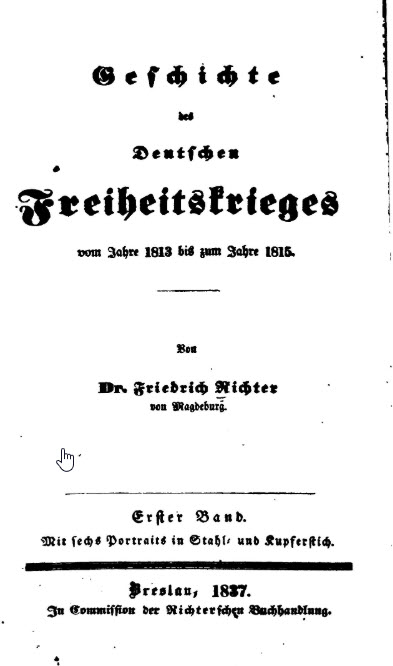
Geschichte des Deutschen Freiheitskrieges vom Jahre 1813 bis zum Jahre 1815 by Friedrich Richter


Friedrich Richter’s Geschichte des Deutschen Freiheitskrieges vom Jahre 1813 bis zum Jahre 1815 is a multi-volume military history in four parts that covers the campaigns of the Wars of Liberation against Napoleonic rule from 1813 to 1815.

The work is structured as a chronological operational history of the coalition wars in Central Europe following the collapse of French dominance after the Russian campaign of 1812. It traces the transition of the German states from Napoleonic client systems into allied forces participating in the wider European struggle against France, including the dissolution of the Holy Roman Empire and the reorganization of German military structures under coalition command.

Volume I typically covers the outbreak of the 1813 campaign, including early mobilization, the formation of coalition armies, and the initial battles in Saxony and surrounding regions. It sets the strategic and political background for the War of Liberation and describes the rebuilding of Prussian and allied forces after earlier defeats.

Volume II continues with the main 1813 operations, including the major engagements around Dresden and Leipzig. This volume focuses heavily on troop movements, battlefield coordination between allied armies, and the escalation of fighting that culminated in the decisive confrontation at Leipzig.

Volume III generally addresses the 1814 campaign in France, when coalition forces advanced westward after the collapse of Napoleon’s position in Germany. It follows the penetration of French territory, siege operations, and the gradual erosion of French military capacity.

Volume IV covers the final phase of the conflict in 1815, including the brief return of Napoleon during the Hundred Days and the concluding operations that ended with his final defeat. It also typically includes reflections on the political and military consequences of the wars for the German states and Europe more broadly.

Across all four volumes, Richter emphasizes operational detail—orders of battle, troop movements, and campaign chronology—within a narrative framework that presents the Wars of Liberation as a formative struggle in modern German history. The work reflects 19th-century historiography, in which the conflict is interpreted not only as a military campaign but also as a step toward national consolidation and identity formation.

(1st Volume)

(2nd Volume)

(3rd Volume)

(4th Volume)


"Uniformenkunde" by Richard Knötel


Richard Knotel was born in Glogau, Germany in 1857. He was a German artist and expert in the study of European Military Uniforms History. Richard Knötel developed an interest in military fashion and history at a very young age. His strong interest in European military history has motivated him to research military installations of different empires and its uniforms. “Uniformenkunde by Richard Knotel” is a huge collection of illustration plates of the armies of Europe from the 17th century to 1914. The Uniformenkunde book is still an important piece of reference on the subject of military attire up to today.

Richard Knötel (January 12, 1857 – April 26, 1914)

Saturday, January 4, 2020

Briefe des westfälischen Stabsoffiziers, Friedrich Wilhelm von Lossberg vom russischen Feldzug des Jahres 1812.


Briefe des westfälischen Stabsoffiziers Friedrich Wilhelm von Lossberg vom russischen Feldzug des Jahres 1812 (Letters from the Westphalian Staff Officer Friedrich Wilhelm von Lossberg on the Russian Campaign of 1812) is a published collection of correspondence written by Friedrich Wilhelm von Lossberg, a Westphalian staff officer serving during the 1812 invasion of Russia. The letters were edited and issued in Berlin in 1910 by R. Eisenschmidt, with editorial work associated with Christian Meyer.

The source consists of first-person wartime letters written during the Napoleonic campaign of 1812, one of the most catastrophic military operations of the era. Lossberg served in the forces of the Kingdom of Westphalia, a state created under French influence and integrated into the wider imperial system of Napoleon’s coalition armies. His correspondence reflects the experience of officers serving in allied contingents within the Grande Armée during the invasion of Russia.

The letters typically describe operational movement, logistical breakdowns, environmental hardship, and the progressive deterioration of discipline and supply during the campaign. As the army advanced deeper into Russian territory, the correspondence captures the increasing strain on manpower, transport, and coordination, culminating in the collapse of the retreat from Moscow. These firsthand accounts provide insight into both tactical conditions and the psychological experience of officers during one of the most devastating campaigns of the Napoleonic Wars.

A key feature of the source is its immediacy. Unlike later narrative histories, the letters were written in real time and reflect uncertainty, fatigue, and evolving perceptions of the campaign’s progress. They also illustrate the position of Westphalian officers operating within a French-dominated command structure, highlighting the complexities of loyalty, obligation, and military hierarchy in Napoleonic satellite states.

As a 1910 edited publication, the collection reflects early 20th-century archival editorial practices, aiming to preserve and present personal wartime documentation for historical study. It is primarily used as a primary source for research on the 1812 campaign, particularly regarding German participation in Napoleon’s Russian expedition and the operational experience of allied contingents.

The von Lossberg Regiment: A Chronicle of Hessian Participation in the American Revolution.


The von Lossberg Regiment: A Chronicle of Hessian Participation in the American Revolution is a modern historical study of a German auxiliary infantry regiment drawn from the landgravial forces of the Electorate of Hesse, focusing on its service in North America during the American Revolutionary War.

The work traces the regiment’s origins within the Hessian military system, its recruitment and organization under the subsidy framework, and its deployment to serve under British command in the American colonies. Like many Hessian units, the von Lossberg Regiment functioned as part of the broader contractual arrangement in which Hesse-Kassel provided trained troops to Britain in exchange for financial subsidies and political support.

A central focus of the book is the operational history of the regiment in North America. It follows the unit through key campaigns, including garrison duty, expeditionary operations, and combat engagements against Continental Army and militia forces. The narrative typically emphasizes marching conditions, supply difficulties, disease, and adaptation to unfamiliar terrain and warfare styles, all of which were significant factors in the experience of German auxiliary troops.

The study also pays attention to leadership, discipline, and regimental identity. Officers such as Friedrich Wilhelm von Lossberg are often highlighted for their command roles and correspondence, which provide insight into the challenges of maintaining cohesion and effectiveness in a transatlantic theater of war far removed from the regiment’s homeland.

Historiographically, the work situates the regiment within the larger phenomenon of German participation in British service during the Revolution. It examines how Hessian units were perceived both by contemporary American observers and by later historical scholarship, addressing long-standing debates about the nature of “Hessian” involvement as professional military service versus mercenary activity.

The History of the Hessian Hussar


"The History of the Hessian Hussar," authored by Carl von Kossecki and Robert Freiherr von Wrangel, is a meticulously researched chronicle of the Royal Prussian 2nd Hessian Hussar Regiment No. 14 and its ancestral Hessian troops from 1706 to 1886. This historical account traces the evolution of the Hessian Hussars of Hesse-Cassel, beginning from the early formation of the Husaren-Compagnie, through its development into the Husaren-Corps, and ultimately culminating in the establishment of the Husaren-Regiment as it stood in 1821.

The book provides an in-depth look at the origins, transformations, and significant milestones of this renowned military unit. It delves into the intricate details of the regiment's organization, tactical developments, and the role it played in various military engagements throughout its history. The authors, with their detailed narrative and comprehensive analysis, bring to life the valor and discipline of the Hessian Hussars, highlighting their contributions to the military history of the region.

Rich in historical detail and analysis, "The History of the Hessian Hussar" is an invaluable resource for historians, military enthusiasts, and anyone interested in the evolution of cavalry tactics and the legacy of the Hessian military tradition in European warfare. 478 pages. 


PURCHASE


Thursday, January 2, 2020

True Presentation and Report of the English-Dutch and Grand Alliance Generals, Chiefly the Duke of Marlborough, Fieldmarshal D’Ouwerkerck and His Serene Highness the Crown Prince of Hessen-Cassel Breaking of the Enemy Lines on the Maas River on July 18, 1705


This title refers to a contemporary-style campaign report describing an episode in the War of the Spanish Succession (1701–1714), specifically Allied operations on the Meuse (Maas) River in 1705.

The work presents a “true report” of the actions of the Anglo-Dutch forces and their allies, focusing on leading commanders such as the Duke of Marlborough, the Dutch field commander Godert de Ginkell, Earl of Athlone (often rendered as Ouwerkerk/‘d’Ouwerkerck’), and the Hereditary Prince of Hesse-Kassel, who later became Landgrave Charles I of Hesse-Kassel. These figures were key leaders in the Grand Alliance’s campaigns against France under Louis XIV.

The central event described is the Allied maneuvering and engagement along the Meuse River in July 1705, when Marlborough’s forces conducted a series of strategic movements designed to threaten French positions in the Spanish Netherlands. The report frames this as a successful Allied “breaking” or penetration of enemy lines, reflecting the operational style of early 18th-century campaigning—where maneuver, supply lines, and fortress networks were often more decisive than large set-piece battles.

Within the broader context of the War of the Spanish Succession, these operations were part of Allied efforts to pressure French frontier defenses and maintain momentum after earlier campaigns in Flanders and the Rhine theater. The emphasis on coordination between English, Dutch, and German contingents highlights the multinational nature of the Grand Alliance and the role of German princes such as Hesse-Kassel in providing auxiliary forces under subsidy agreements.

As a genre, the text belongs to early modern campaign reporting or commemorative military narration. Such works often blend operational description with political justification and celebratory framing of success, especially regarding prominent commanders like Marlborough, whose reputation was actively shaped through printed accounts during and after the war.


Birds-eye view print shows plan of the battlefied with troop locations between Mechelen and Loeven. Depiction of the battle outside of Hallishem, Belgium between the Gete and Meus (Maas) rivers. Key activities in the print are labeled 1-5. On July 18, 1705, the Duke of Marlborough and allied generals successfully broke through the French forces holding the Lines of Brabant at the small village of Elixham in Belgium. The Lines of Brabant were a strategic arc of defensive fieldworks stretching from Antwerp to Namur in Belgium.

Wednesday, January 1, 2020

Anno Dreizeh : Der Uebergang Der Beiden Westphälischen Husarenregimenter Unter Oberst v. Hammerstein UND Major v. Pentz Zu Den Fahnen Der Verbündeten in Der Nacht Vom 22. Zum 23. August 1813


Anno Thirteen: The Transition of the Two Westphalian Hussar Regiments under Colonel von Hammerstein and Major von Pentz to the Flags of the Allies in the Night of 22–23 August 1813 (Marburg: Koch, 1813) is a contemporary wartime pamphlet or report describing the defection of two cavalry regiments from the forces of the Kingdom of Westphalia to the anti-Napoleonic coalition during the German campaign of 1813.

The text focuses on the dramatic shift of allegiance by the two Westphalian hussar regiments commanded by Colonel von Hammerstein and Major von Pentz. In the night of 22–23 August 1813, during the broader collapse of Napoleonic control in Central Europe, these units are described as breaking from their assigned French-aligned command structure and joining the Allied forces opposing Napoleon. This event occurred during the wider War of Liberation phase of the War of the Sixth Coalition.

The pamphlet presents the defection as a decisive and symbolic moment, emphasizing loyalty shifts within German auxiliary forces that had previously served under Napoleonic satellite regimes. Such transitions were not uncommon in 1813, as military pressure increased following French setbacks in Russia (1812) and widespread unrest among German contingents serving under Westphalian administration.

The narrative likely highlights the coordination, secrecy, and timing of the move, framing it as a deliberate act of alignment with the “national” or “liberation” cause. It reflects the rapidly changing political and military landscape in which units raised under French influence began to reorient toward coalition forces, especially Prussia and its allies.

As a 1813 publication from Marburg, the work functions both as a report and as wartime propaganda, intended to document and legitimize the defection of troops from a Napoleonic client state. It is valuable today as a primary source illustrating the fragmentation of Westphalian military structures in the final year of its existence and the fluid loyalties of German units during the late Napoleonic Wars.