Wednesday, March 25, 2020

Dörnberg Against Bonaparte: Westphalia 1809


Immerse yourself in the gripping tale of the Dörnberg Uprising, a daring effort to seize control of Kassel, the capital of Westphalia, during the tumultuous reign of Napoleon's youngest brother, King Jerome Bonaparte. This meticulously crafted narrative unfolds before your eyes, delivering an enthralling and vivid account of a pivotal historical moment.

This book is a must-read for anyone with a passion for military history, offering a unique blend of two distinct perspectives. The first part of the work is presented in novel form, bringing to life the dramatic events and characters of the uprising. In contrast, the latter part delves into a meticulously documented account, providing an intimate and detailed record of this significant episode during the French occupation of Hessen-Kassel.

Prepare to be captivated by a riveting narrative that combines the art of storytelling with historical precision, offering readers a profound insight into the brave individuals who sought to alter the course of history in a time of uncertainty and conflict. Explore the complexities of power, courage, and perseverance against the backdrop of one of the most significant events of the Napoleonic era.125 pages.

PURCHASE

Dörnberg Against Bonaparte: Westphalia 1809

Friday, March 20, 2020

Bauern Gegen Bonaparte: Hessen-Kassel 1809


Bauern gegen Bonaparte: Hessen-Kassel 1809 (Peasants Against Bonaparte) by Curt Hotzel (Berlin: Verlag der Nation, 1953) is a study of rural unrest in the Electorate of Hesse during the Napoleonic era, with emphasis on the year 1809. It examines how village populations responded to the political and military pressures of French domination in Central Europe, particularly under the administration of the Kingdom of Westphalia.

The book focuses on the impact of conscription, taxation, and administrative reforms imposed during the Napoleonic period. These measures disrupted traditional rural life, creating friction between local communities and state authorities. Hotzel describes instances of draft resistance, evasion of military service, and localized forms of protest, presenting them as reactions to intensified wartime demands and foreign-imposed governance structures.

A major theme is the relationship between military systems and peasant society. The expansion of conscription networks tied rural populations more directly to continental warfare, making villages a source of manpower for armies engaged in conflicts far beyond their immediate region. The work highlights how these pressures were experienced locally, especially in areas affected by repeated recruitment and requisitioning.

Published in East Germany in 1953, the book reflects a historiographical approach influenced by social and economic interpretations of history. It tends to emphasize class dynamics and popular resistance, framing peasant behavior as a response to structural pressures rather than isolated incidents.

Tuesday, March 17, 2020

Dragoons and Hussars


DRAGOONS AND HUSSARS

"Toelle and Henkel's 'Dragoner und Husaren in Grebenstein 1763-1870'" immerses readers in the enthralling world of elite Hessian cavalry, focusing on the Dragoon and Hussar Regiments. This meticulously researched book provides a detailed and informative account of these exceptional fighting units, chronicling their exploits from 1763 to 1870.

Set against the backdrop of Grebenstein, a quaint agricultural town in the northern reaches of the country, the narrative unfolds within the quarters that housed Hessian troops for many years. The book delves into the pivotal military reforms that swept through Hesse-Cassel, driven by Landgrave Friedrich II's admiration for Prussian military practices.

Readers passionate about historical military accounts will find themselves captivated by the in-depth and true-to-life records of these highly distinguished cavalrymen. 202 pages.


PURCHASE

Dragoons and Hussars


Monday, March 2, 2020

The Hessians in the French Revolutionary Wars: 1792, 1793 & 1794


Step back in time and delve into history with this extraordinary manuscript. At its core lies General-Lieutenant Friederich Wilhelm von Loßberg's personal letter diary, chronicling his experiences during the campaigns from 1792 to the Basel Peace in 1795. This invaluable document, akin to his renowned "Letters Home" penned during the harrowing 1812 Russian campaign, provides a captivating window into a bygone era.

In this meticulously translated and expertly edited English edition, von Loßberg's vivid recollections of the Landgräflich Hessen-Casselsche Garde-Grenadier-Regiment come to life. It offers a poignant and intimate account of his role in shaping the history of these campaigns.

Immerse yourself in the world of military strategy, camaraderie, and the trials of war as you follow Loßberg's journey. This book stands as a testament to his contributions, offering a compelling narrative that transports you back in time and ensures his place in the annals of history. 429 pages.


PURCHASE

THE HESSIANS IN THE FRENCH REVOLUTIONARY WARS: 1792, 1793 & 1794 MEMORIES OF THE CAMPAIGNS


Saturday, January 18, 2020

Die Kriegsbaukunst im Felde: ein Leitfaden fuer den Unterricht in Militair-Schulen, und als Handbuch fuer die Officiere aller Waffen


Die Kriegsbaukunst im Felde. Ein Leitfaden für den Unterricht in Militair-Schulen, und als Handbuch für die Officiere aller Waffen (Dresden & Leipzig, 1832, Arnoldische Buchhandlung) is a German military engineering manual focused on field fortification and applied military construction (Kriegsbaukunst im Felde). It was written as both an instructional textbook for military academies and a practical reference for officers of all branches of service.

The work belongs to the early 19th-century tradition of professionalizing officer education in the German states, where increasing emphasis was placed on engineering knowledge, standardized instruction, and the scientific study of warfare. It covers the principles of constructing field fortifications, entrenchments, defensive positions, and temporary military works, as well as the organization of labor and materials required in campaign conditions.

A key feature of such manuals is their practical orientation. Rather than focusing on abstract theory, they aim to prepare officers for real operational conditions—how to quickly fortify positions under enemy pressure, how to adapt terrain for defense, and how to coordinate infantry, artillery, and engineer troops in constructing battlefield works. This reflects the influence of Napoleonic-era warfare, where rapid movement and field engineering became essential components of military success.

The intended audience includes cadets in military schools and serving officers across different arms, which is reflected in its systematic and didactic structure. It likely includes diagrams, step-by-step instructions, and standardized procedures for constructing works such as redoubts, trenches, abatis, and bridges. In this sense, it functions as both a teaching aid and a field handbook.


Friday, January 10, 2020

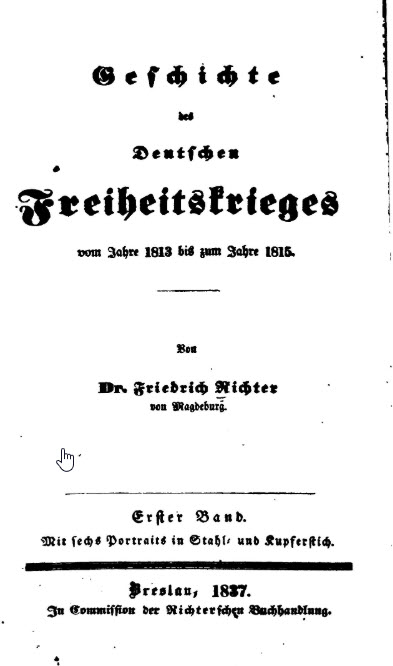
Geschichte des Deutschen Freiheitskrieges vom Jahre 1813 bis zum Jahre 1815 by Friedrich Richter


Friedrich Richter’s Geschichte des Deutschen Freiheitskrieges vom Jahre 1813 bis zum Jahre 1815 is a multi-volume military history in four parts that covers the campaigns of the Wars of Liberation against Napoleonic rule from 1813 to 1815.

The work is structured as a chronological operational history of the coalition wars in Central Europe following the collapse of French dominance after the Russian campaign of 1812. It traces the transition of the German states from Napoleonic client systems into allied forces participating in the wider European struggle against France, including the dissolution of the Holy Roman Empire and the reorganization of German military structures under coalition command.

Volume I typically covers the outbreak of the 1813 campaign, including early mobilization, the formation of coalition armies, and the initial battles in Saxony and surrounding regions. It sets the strategic and political background for the War of Liberation and describes the rebuilding of Prussian and allied forces after earlier defeats.

Volume II continues with the main 1813 operations, including the major engagements around Dresden and Leipzig. This volume focuses heavily on troop movements, battlefield coordination between allied armies, and the escalation of fighting that culminated in the decisive confrontation at Leipzig.

Volume III generally addresses the 1814 campaign in France, when coalition forces advanced westward after the collapse of Napoleon’s position in Germany. It follows the penetration of French territory, siege operations, and the gradual erosion of French military capacity.

Volume IV covers the final phase of the conflict in 1815, including the brief return of Napoleon during the Hundred Days and the concluding operations that ended with his final defeat. It also typically includes reflections on the political and military consequences of the wars for the German states and Europe more broadly.

Across all four volumes, Richter emphasizes operational detail—orders of battle, troop movements, and campaign chronology—within a narrative framework that presents the Wars of Liberation as a formative struggle in modern German history. The work reflects 19th-century historiography, in which the conflict is interpreted not only as a military campaign but also as a step toward national consolidation and identity formation.

(1st Volume)

(2nd Volume)

(3rd Volume)

(4th Volume)


"Uniformenkunde" by Richard Knötel


Richard Knotel was born in Glogau, Germany in 1857. He was a German artist and expert in the study of European Military Uniforms History. Richard Knötel developed an interest in military fashion and history at a very young age. His strong interest in European military history has motivated him to research military installations of different empires and its uniforms. “Uniformenkunde by Richard Knotel” is a huge collection of illustration plates of the armies of Europe from the 17th century to 1914. The Uniformenkunde book is still an important piece of reference on the subject of military attire up to today.

Richard Knötel (January 12, 1857 – April 26, 1914)