
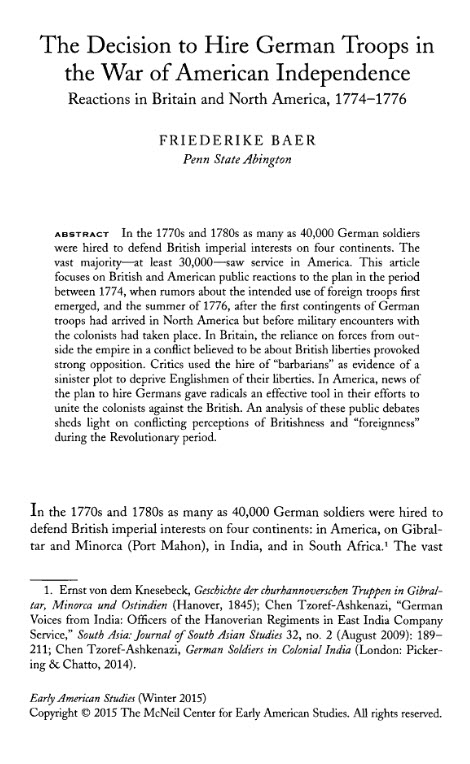
Friederike Baer’s “The Decision to Hire German Troops in the War of American Independence: Reactions in Britain and North America, 1774–1776” (2015) examines the political decision-making process behind Britain’s use of German auxiliary forces—especially from the Electorate of Hesse—at the outbreak of the American Revolutionary War, and how that decision was received on both sides of the Atlantic.
The article traces how British ministers, facing a shortage of domestic troops and the growing scale of rebellion in North America, turned to established subsidy networks with German principalities. Baer emphasizes that this was not an improvised measure but part of a long-standing European practice of hiring allied contingents, particularly from Hesse-Kassel, which had a well-developed system of professionalized, exportable military forces.
A major focus of the study is the political debate within Britain surrounding the use of German troops. Baer shows that while the decision was justified on pragmatic military grounds, it also generated criticism in Parliament and public discourse, where opponents questioned both the cost and the political wisdom of relying on foreign auxiliaries to suppress colonial rebellion.
The article then examines reactions in North America, where the arrival of German troops was quickly incorporated into revolutionary propaganda. American political writers framed the “Hessians” as mercenaries hired to enforce imperial tyranny, a portrayal that became influential in shaping popular perceptions of German auxiliaries throughout the war. Baer contrasts this image with the administrative reality of the troops as contractual state soldiers bound by formal treaties between Britain and German rulers.
Finally, the study situates the decision within broader eighteenth-century military systems, showing how Britain’s reliance on German troops reflected structural limitations in its standing army and the functioning of transnational military labor markets in Europe. It highlights the intersection of diplomacy, finance, and military logistics in the formation of coalition warfare.
Baer’s analysis ultimately reframes the hiring of German troops as both a practical solution to wartime constraints and a politically contested choice that shaped perceptions of legitimacy, loyalty, and foreign intervention during the early stages of the American Revolution.
